

Couples therapy is not automatically safe because a professional is in the room. If speaking honestly could lead to threats, punishment, forced disclosure or retaliation afterward, the next step needs to account for that risk.
Before joint sessions, ask about safety screening, confidentiality, relevant experience and whether the service fits your goals. If abuse or coercive control is present, contact a specialist privately through a safe route rather than relying on a communication exercise to protect you.
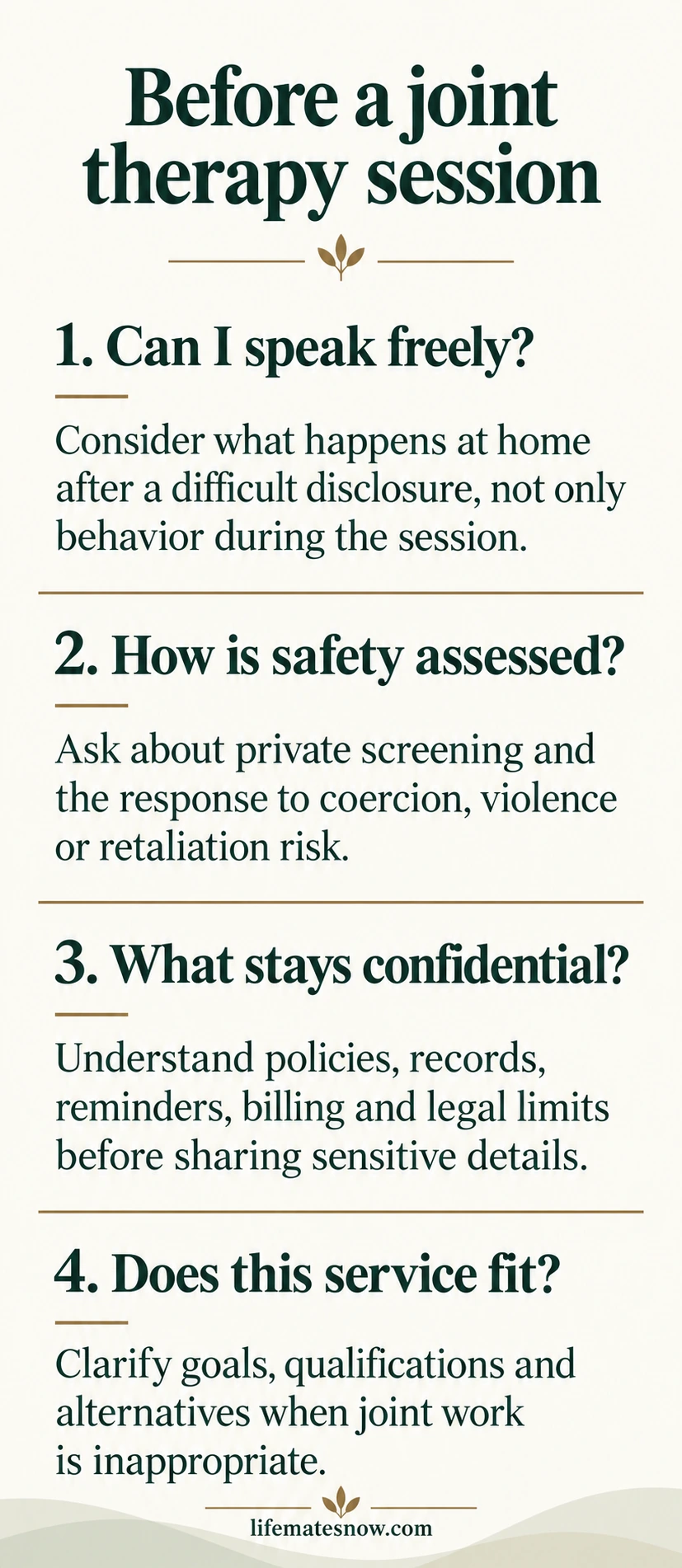
Four questions before a joint session
Read the guide as text
- Can I speak freely?. Consider what happens at home after a difficult disclosure, not only behavior during the session.
- How is safety assessed?. Ask about private screening and the response to coercion, violence or retaliation risk.
- What stays confidential?. Understand policies, records, reminders, billing and legal limits before sharing sensitive details.
- Does this service fit?. Clarify goals, qualifications and alternatives when joint work is inappropriate.
Using Honesty in and Out of the Session
If you go to a session and say something hard, like wanting more independence or sexual boundaries that are being ignored, what will happen when you go home later that night? If you think your partner is going to threaten you, force you to explain, or punish you, then tell the qualified professional privately using a different communication route that's safe. Don't just think the therapist is going to notice the risk without you giving them information.
The National Domestic Violence Hotline explains why couples counseling can be dangerous in abusive relationships. Disclosures can be used against the person being harmed, and ordinary relationship framing may obscure unequal power. A calm session is not proof of safety. A person may appear cooperative with the therapist and retaliate later. The relevant question is whether participation increases your freedom and safety in daily life, not whether both people can remain polite for an hour.
Seeing Control Patterns
Ordinary conflicts can cause frustration, poor listening, and even disagreements. Coercive patterns, by the way, mean restricting another person's choice through intimidation, fear, monitoring or other controlling behavior. Both people might yell during a conflict, but this doesn't mean there's equal power or equal responsibility. Who's allowed to refuse, who leaves the room, who has access to money, and who's able to make independent decisions.
Don't just make a checklist to figure out if you have experienced enough harm to get help. You can get any kind of private advice without there being a certain behavior on the label first. A communication exercise shows clear expressions that should be heard and respected. If the problem is that one of the people punishes a disagreement, better wording doesn't address the real issue. The provider needs to assess the pattern rather than assume the harmed person needs better wording to manage it.
Make Sure Both Partners Feel Comfortable with Counseling
Sometimes one partner wants to attend couples counseling more than the other, and that's understandable. But going to counseling should never involve threats, financial pressure, intimidation, or punishment because someone isn't ready to participate. There's also a difference between explaining that you're unwilling to stay in a relationship without certain changes and trying to force your partner to attend counseling or share things they're not comfortable discussing.
It's important to think about whether both people actually have a choice. Can either partner ask questions, refuse to participate in a particular exercise, or explain that they don't feel comfortable with the therapist? Can they talk to someone individually about their concerns without worrying about how their partner will react?
If you're only agreeing to counseling because you're afraid of what might happen if you refuse, consider talking privately with a qualified professional when it's safe to do so. You don't have to bring up these concerns in front of the person who's pressuring you, especially if you're worried about their reaction.
Remember that agreeing to attend counseling doesn't mean you're automatically agreeing to discuss every personal detail of your life. You should still have a say in what you're comfortable sharing, whether it involves your sexual experiences, health, finances, or painful memories from the past. A good therapist should explain how counseling works and respect appropriate personal boundaries instead of making you feel pressured to reveal everything before you're ready.
Talk About Safety Before Starting Couples Counseling
Before beginning couples counseling, it's a good idea to ask the therapist how they handle concerns about abuse, controlling behavior, or feeling unsafe in a relationship. Not every couple seeking counseling is dealing with ordinary communication problems, and it's important that the therapist understands the difference.
You might ask something like, "Do you meet with each person separately before starting couples counseling? And if someone has concerns about their safety, can they discuss those privately without everything automatically being shared with their partner?"

It's also important to understand the therapist's privacy policies and any limits to confidentiality before discussing sensitive information. This can help you decide what you're comfortable sharing and whether the counseling process feels appropriate for your situation.
Having individual conversations with a therapist doesn't automatically mean couples counseling will be the right option. But it can help a qualified professional better understand what's happening in the relationship, recognize possible safety concerns, and decide whether another type of support might be more appropriate.
If a therapist insists that every concern must be discussed with both partners present without first considering safety, it's okay to look for another professional opinion. You shouldn't have to reveal something that could put you at risk just to find out how a therapist will respond.
Instead, ask questions about their approach before sharing sensitive details. If you're concerned about how your partner might react, try contacting the therapist privately using a phone, email account, or another communication method that feels safe.
The important thing is remembering that counseling should be a place where both people feel respected and supported. It shouldn't become another situation where someone feels controlled, intimidated, or pressured into discussing things they're not ready to share.
What is the Confidentiality Policy?
Couples therapists might use different policies about contact and information that's shared outside the sessions. Some have a no-secrets policy, while others keep confidentiality strictly. Don't just assume the policy matches what you want.
Ask what happens if one partner talks to the therapist privately, what records are kept, who can have access to them, and when the information has to be disclosed under the rules. Ask how billing, appointment reminders, and online portals handle the information.
A privacy policy doesn't override legal or safeguarding duties. The details depend on the provider and location. The professional should tell you relevant limits in understandable language.
If you're worried about being monitored, don't share information on the portal or the device, or send out sensitive messages without thinking about the risk. A good confidentiality question includes how the service communicates with you, not whether the therapist talks about the session as being private.
Pay Attention to Crisis
An immediate risk includes suicide, severe intoxication, medical problems, or another urgent crisis. This can require emergency help or specialized care before a relationship discussion should be had. A regular appointment shouldn't be treated as the only response available.
In the United States, call or text 988 for suicide or mental health crisis support. Contact emergency services for immediate danger or a medical emergency. Outside the United States, use appropriate local crisis services.
A mental health diagnosis, medication use, and a history of substance abuse don't automatically mean couples therapy is unsafe. Risk, capacity, and stability all matter in the doctor's assessment.
Don't use a partner's diagnosis to dismiss their concerns or to take control of their choices. The question is what support is appropriate now. Individual treatment, medical care, and relationship work can have different roles and need different consent.
What Skills Does the Therapist Have?
Training and counseling don't mean they're an expert in every kind of situation. Ask about their experience with coercive control, trauma, disability, cultural context, LGBTQ+ relationships, or the issue you want to ask about.
Verify their professional status with a regulator when you need to, because a certification in a branded method isn't the same as a professional license.
The National Institute of Mental Health offers guidance on psychotherapy and choosing a provider. Questions about qualifications, approach, goals, costs, and progress can help you assess fit.
You can ask how the therapist responds if joint sessions turn out to be inappropriate. A good answer should include a plan for an assessment and a referral, not a promise that the method will save every relationship. Guarantees about staying together are not good medical care.
Make Sure You Both Understand What You Want from Counseling
Sometimes two people enter couples counseling with completely different ideas about what they want to accomplish. One partner might be hoping to repair the relationship, while the other is looking for help deciding how to separate. This doesn't necessarily mean either person is being dishonest or that counseling can't help. But it does mean you need to be clear about what each of you is hoping to get out of the experience.
Before getting started, ask what type of counseling or professional support is actually being offered. Traditional couples counseling, individual therapy, counseling focused on making relationship decisions, and services that help couples navigate separation aren't all the same thing. Some professionals specialize in certain situations, so it's important to find someone whose approach fits your needs.
You also shouldn't feel pressured to agree that you want to save the relationship just because you're hoping to have a more peaceful conversation about separating. At the same time, if your partner agrees to attend counseling, that doesn't automatically mean they've decided to stay in the relationship.
Sometimes it's helpful to start with something simple, like, "We're not sure what we want for the future of our relationship, and we'd like some help figuring out what kind of counseling would be best for us."
If there are concerns about safety, threats, or controlling behavior, try discussing those privately with a qualified professional before beginning joint conversations. Counseling should help you understand your options; not make you feel like you have to negotiate your right to leave a relationship or protect yourself.
Pay Attention to How Your Concerns Are Handled
Even after you've started couples counseling, it's important to pay attention to how the therapist responds to serious concerns. For example, if a therapist minimizes threats, treats forced sexual contact as an ordinary disagreement between partners or pressures you to share personal information that could put you at risk, those are warning signs worth taking seriously.
You should also notice whether the therapist listens when you express concerns about how your partner might react after a difficult conversation. If you're worried about retaliation or feeling unsafe, those concerns shouldn't be ignored or brushed aside.
Of course, counseling isn't always comfortable. Sometimes a therapist might ask difficult questions or encourage both partners to recognize behaviors that are affecting the relationship. Feeling uncomfortable during those conversations doesn't automatically mean something is wrong. But there's a difference between being respectfully challenged and feeling pressured, dismissed, or unsafe.
If you don't understand why a therapist is suggesting a particular exercise or conversation, it's okay to ask questions. You might say, "Can you explain what this exercise is supposed to help us accomplish and how you've determined that it's appropriate for our situation?"
You also have the right to decline any exercise while asking for more information. Participating in counseling doesn't mean you have to agree to everything a therapist suggests, especially when something makes you concerned about your safety.
If you continue feeling dismissed or notice that things are becoming worse, consider getting advice from another qualified professional. Depending on what happened and where you live, you might also have the option of reporting serious concerns to a professional licensing or regulatory organization.
Remember that you don't have to continue seeing a therapist simply because you've already spent time or money on counseling. The goal should be to find support that respects your circumstances, takes safety seriously, and helps you make informed decisions about your relationship.
Get Separate Therapy
Individual therapy can help you look at your own feelings, common choices, and boundaries. A domestic abuse advocate can help with safety planning and resources, and a doctor can assess health or crisis needs. A legal advisor can explain your rights and obligations.
All of these roles have different questions. One professional shouldn't be expected to do what the others do. Ask for a referral when you have a need and when your situation doesn't work with the current service.
A person who's using abusive behavior might need accountability-focused intervention. The person who's being harmed shouldn't be responsible for supervising, arranging, or guaranteeing a change.
Pick separate support because this doesn't mean the relationship has no hope. This means the task in front of you needs to be safe, looked at, and there needs to be individual care instead of joint communication. The value of support is whether it helps people understand their options and act more safely, rather than whether both partners sit in the same room.
An Example of When Couples Counseling Might Not Be the Right Fit
Imagine if there is a couple who decides to try counseling because they keep arguing about money and spending. At first, it seems like they simply need help communicating and managing their finances. But during a private conversation with the therapist, one partner explains that every purchase they make is monitored and that disagreements about money often lead to threats about losing their home.
At this point, the problem isn't just about learning how to discuss a budget or make financial decisions together. The therapist needs to consider whether controlling behavior or emotional abuse is involved and whether couples counseling would actually be safe. Depending on the situation, individual counseling or another type of professional support might be more appropriate.
The person who shared these concerns shouldn't have to repeat everything in front of their partner just to prove that it's happening. But it's also important to understand the therapist's confidentiality policies and any legal responsibilities they might have. That's why discussing privacy and its limits before sharing sensitive information is so important.
Even though this is just an example, it shows how learning more about a relationship can change the type of support a couple needs. What originally seemed like an ordinary disagreement about finances might involve much more serious concerns. A counseling approach that sounded appropriate at first might not be the safest or most helpful option once the therapist understands what's actually happening.
Pause joint work when you need another approach
When you're safe, contact the provider privately and ask about taking time to pause. You might want to talk about concerns, ask for an individual consultation, or get a referral somewhere else.
If changing attendance could alert a partner who's controlling, talk to the specialist first. Do not assume that canceling, changing a password, or blocking reminders has no risks. Administrative actions can still create notifications.
Ask about fees, records and future contact so there are fewer unexpected messages. You can request a safe way to communicate and recognize that the service might have practical or legal limits.
You don't owe the therapist a joint session if it would make you unsafe, and you don't need to stay in treatment just to prove you tried. The next step should be chosen with attention to your actual risk and to support your needs.
Making Informed Decisions
Before you start or continue couples therapy, ask if both people are safe to speak, whether the professional can assess the relevant risks, and whether the goals and confidentiality rules are clear.
If any of the answers aren't sure, then get clarification or get advice somewhere else. Uncertainty is a reason for the assessment, not a reason to force conversations and hope that the setting is going to protect everyone involved.
You can decide you want a better relationship and still pick a different kind of support. You can value therapy and still decide that a certain therapist, method, or timing doesn't work for you.
Good care needs to help people understand their options and act with more safety and freedom. In an unsafe or unclear situation, private questions may be a better first step than a shared session. Choosing this step can be a thoughtful decision about the right kind of help, not proof of how much you care about someone.
Prepare for a private therapy consultation
Choose the concern you want to discuss individually before deciding whether a joint session is appropriate.
This is a question list, not a safety assessment. If there is immediate danger, seek local emergency help when safe.
Use the questions and examples in the article above; the draft builder needs JavaScript.
15 questions readers ask
1. When may couples therapy be unsafe?
It may be unsafe when honest participation can lead to retaliation, coercion, threats or further control. Safety outside the session matters.
2. Is abuse simply a communication problem?
No. Better phrasing cannot make another person stop punishing disagreement. Specialist assessment should consider power, control and safety.
3. Should I disclose abuse in front of my partner?
Do not assume that is safe. Seek private specialist guidance through a safe communication route before a joint disclosure.
4. What should I ask about screening?
Ask how the provider assesses violence, coercive control, retaliation and whether joint sessions are appropriate, including opportunities for private contact.
5. Does private screening guarantee safety?
No. Screening helps inform assessment but cannot guarantee what happens after a session. An individualized plan may still be needed.
6. Are couples-therapy conversations always confidential?
Policies and legal duties vary. Ask how private contact, records, access and required disclosures are handled before sharing sensitive information.
7. What is a no-secrets policy?
It describes how a provider handles information shared separately during couples work. Ask for the exact policy and how safety concerns affect it.
8. Can reminders or billing expose a private contact?
They can reveal information. Ask about portals, messages, calls, bills and safe contact details before relying on an appointment being private.
9. What if participation is pressured?
Fear, threats and financial punishment undermine voluntary participation. Consider private advice about the situation rather than treating attendance as proof of commitment.
10. Does a diagnosis make couples therapy unsuitable?
A diagnosis alone does not decide suitability. Current risk, capacity, goals and appropriate clinical support matter.
11. What if there is an immediate crisis?
Use appropriate emergency or crisis support. In the United States, call or text 988 for crisis support; immediate danger or a medical emergency may require emergency services.
12. What if one partner wants repair and the other separation?
Clarify the goals and type of service before starting. Attendance does not mean either person has agreed to remain in the relationship.
13. Can I decline an exercise?
You can ask its purpose and decline while seeking clarification, especially if it could put you at risk. Appropriate care should take those concerns seriously.
14. What alternatives might be useful?
Depending on the need, options include individual therapy, a domestic abuse advocate, medical care or legal advice. Their roles differ.
15. Do I have to continue to prove I tried?
No. Time or money already spent does not obligate you to remain in unsuitable or unsafe treatment. Plan changes with attention to your actual risk.