

Choosing a couples therapist involves more than finding an open appointment. You need to understand the person’s qualifications, how they work with two partners and whether the arrangement fits your goals, privacy and budget.
Use an initial conversation to ask plain questions. You are allowed to compare providers, request written policies and decide that a particular therapist is not the right fit.
Four checks before booking regular sessions
Read the guide as text
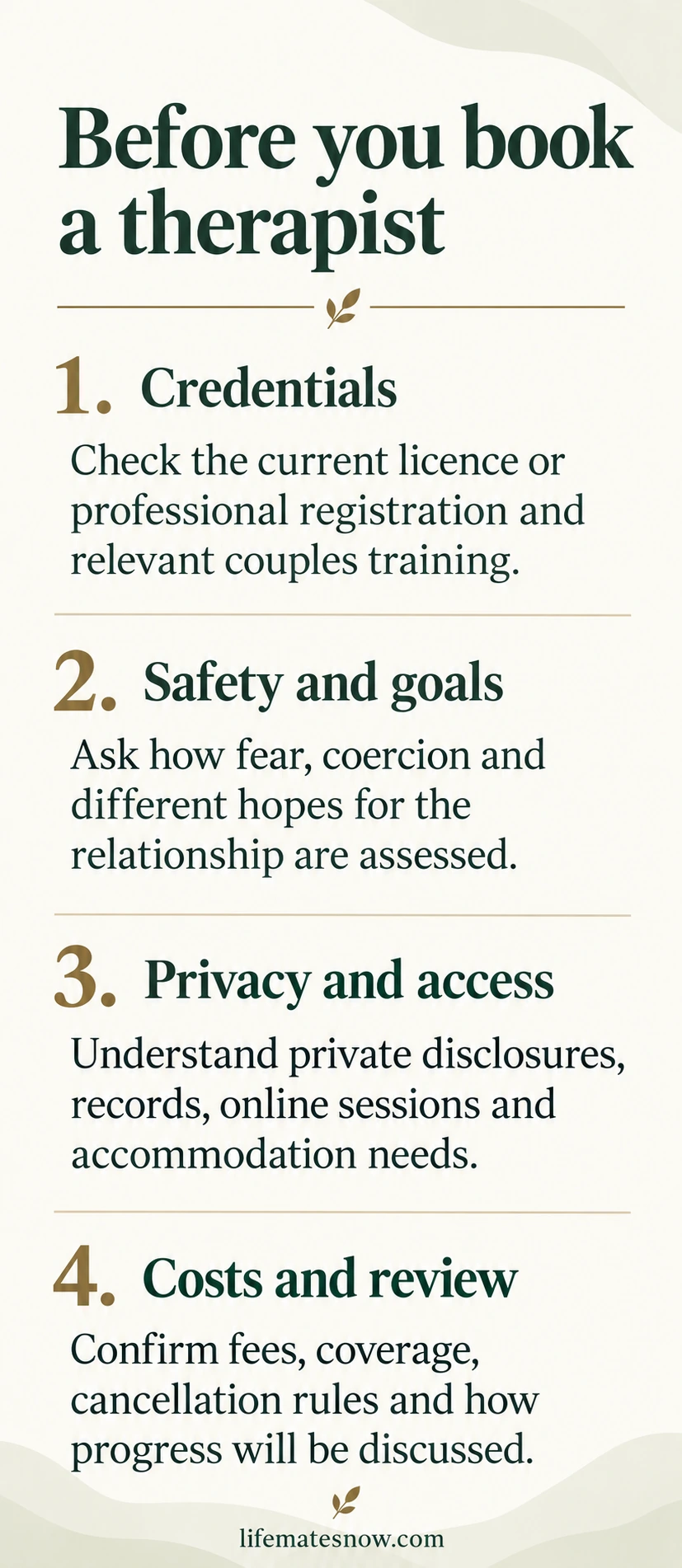
- Credentials. Check the current licence or professional registration and relevant couples training.
- Safety and goals. Ask how fear, coercion and different hopes for the relationship are assessed.
- Privacy and access. Understand private disclosures, records, online sessions and accommodation needs.
- Costs and review. Confirm fees, coverage, cancellation rules and how progress will be discussed.
Start with Your Own Questions
Before you look for a therapist, write a short description on what you hope could change. Try to name the pattern instead of building a case against your partner. Then something like, “We want to be able to talk about money without it ending in insults,” is a better question than, “I need someone to explain that my partner is irresponsible.” A therapist can help you to see patterns but shouldn’t be made a referee who is meant to be on one side.
The goals might be different. One partner might want to rebuild the relationship, and the other might want to help decide if they want to continue. Talk to the therapist early and find out how to work on mixed goals.
You don’t have to agree with everything they say to get a consultation. A consultation should help you decide whether you want to participate; it does not oblige you to begin treatment or disclose sensitive details. If going to therapy is being forced through threats or control, talk about it privately with a professional before you agree to joint therapy sessions.
Knowing the Professional Qualifications
You might want to ask what their license is or what kind of qualifications they hold. Titles can vary by location, and a training certificate doesn’t always mean that someone is able to give mental health treatment.
Check the relevant professional regulator’s public register and whether the person’s current credentials cover the service you want. A good website or directory listing shouldn’t be seen as licensure.
NIMH suggests asking prospective therapists about credentials, experience, approach, goals, fees and confidentiality. These are reasonable questions for a prospective provider.
If the person is a trainee, ask who supervises the work, what you are consenting to and how records are handled. Supervised care can be a good option, but it should be known before you start.
Find Care That is Experienced
You can ask how much of the work they do is with couples and what kind of training they have in that work. Individual therapy experiences don’t automatically tell you how someone handles the two clients that have different points of view in one room.
Talk about issues that are relevant to you such as infidelity, parenting conflicts, sexual concerns, and illness. Ask how they see if their expertise fits what you need. A good response tells you the relevant experiences without promising that your situation is the same as someone else’s. The therapist should help protect a former client’s privacy and should avoid offering stories as proof.

If you are concerned about something and need a specialist, ask about referrals. Confidence is reassuring only when it has clear limits. No therapist has to be the right provider for every couple’s problem.
How Safety is Measured
One thing you should ask is how they look for abuse, control, and fear of consequences after a session. Ask whether each partner has an opportunity to raise these concerns privately and how that information is handled.
These things matter because an argument between people who disagree freely is different from a relationship where one person has to deal with threats, surveillance, control, or retaliation. Regular communication exercises might be unhelpful if the situation is abusive.
The National Domestic Violence Hotline does not recommend joint counseling with an abusive partner. If this applies to you, seek private specialist support rather than relying on a couples consultation to make disclosure safe.
A good answer should explain the process and limits. For example, saying "I treat everyone equally" doesn't show how a therapist would look at a power imbalance or whether the session could lead to danger afterwards.
Make Sure You're Both Working Toward the Same Goal
Before starting couples counseling, it's important to understand what you and your partner are hoping to accomplish. Sometimes both people want to repair their relationship and rebuild the connection they've lost. But there are also situations where one person wants to stay together while the other isn't sure whether the relationship can or should continue. When this happens, it can help to find a therapist who understands that both people might be coming into counseling with different expectations.
One thing you might want to ask a potential therapist is how they handle situations where couples don't agree about the future of their relationship. For example, you could ask, "What happens if I want to work things out, but my partner isn't sure they want to stay together?" Their answer can help you understand whether they're comfortable working with couples who are still trying to decide what they want. They might also recommend a different type of counseling that's more appropriate for your situation.
It's also important to remember that couples counseling doesn't always have to focus on saving a relationship. Some couples want to rebuild trust, improve communication, or become emotionally closer. Others might need help deciding whether they should stay together or finding ways to separate respectfully. These situations can involve similar feelings and challenges, but they don't necessarily require the same approach.
Be careful about working with someone who promises that they can save every marriage or makes you feel that separating automatically means you've failed. Every relationship is different, and there isn't one solution that works for everyone. At the same time, a therapist shouldn't decide whether you should stay together or break up after hearing only a small part of your story. Their role should be to help you understand your situation, explore your options, and make your own decisions.
For an illustrative example, imagine Melissa and Brandon considering couples counseling after Brandon was unfaithful. Melissa wants to repair their relationship and rebuild the trust they've lost, but Brandon isn't sure whether he wants to continue the marriage. Before scheduling regular appointments, they ask the therapist whether counseling can help them figure out what they both want before they begin working on rebuilding their relationship.
This gives them an opportunity to understand what counseling might involve without assuming that they're already committed to the same outcome. Instead of immediately focusing on exercises designed to bring them closer together, they can begin by discussing their expectations and whether they're both willing to work toward repairing the relationship.
The important thing is finding professional support that fits your circumstances instead of feeling pressured to follow a plan that doesn't reflect what you or your partner actually wants. Sometimes the first step isn't figuring out how to save the relationship. It's understanding whether both people want to continue and what kind of help they need to make that decision.
Asking Which Approach is the Best
You might hear things about emotionally focused therapy, behavioral ideas, or the Gottman Method. Instead of picking one label, ask, “What could the session help with?” Find out if there would be individual meetings or if they would be joint, and find out what would need to be done in between appointments. Find out how the therapist decides how to start the sessions.
A named method is one part of a provider’s approach. Ask what assessment and sessions would involve for your particular concerns, and how the therapist would review whether the work is useful.
A good therapist can explain their reasoning plainly. You shouldn’t have to accept big terms that you don’t understand when you’re asking questions and considering getting therapy.
Understand How Privacy Works in Couples Counseling
Before starting couples counseling, it's important to understand how your personal information will be handled. You might assume that everything you share with a therapist will be kept private in the same way it would during individual counseling, but couples counseling can work differently. That's why it's a good idea to ask the therapist how they handle confidentiality and what information might be shared between you and your partner.
One of the first things you might want to ask is who the therapist considers their client. Are they working with you and your partner as a couple, or do they consider each of you an individual client? This might seem like a small detail, but it can affect how records are kept, what information can be shared, and how the therapist communicates with each person outside of your regular appointments.
It's also important to ask what happens if you tell the therapist something privately. For example, maybe you contact the therapist between appointments because there's something you're not comfortable discussing in front of your partner. Some therapists have policies about keeping information shared privately confidential, while others explain that certain information affecting the relationship might need to be discussed during joint appointments. Understanding these rules ahead of time can help prevent confusion or unexpected situations later.
You might ask something like, "If I share something with you privately, will you keep it between us, or could it come up during our appointments together?" This gives the therapist an opportunity to explain their approach before you share anything sensitive. You and your partner should both understand how private conversations are handled and what the therapist expects when it comes to honesty during counseling.
There are also other privacy questions worth asking before getting started. For example, who can access your counseling records? How are emails and messages stored? Are appointments ever recorded? Are there situations where the therapist might be legally required to share information? These questions can help you understand what privacy protections are in place and whether there are limits to confidentiality.
Remember that the privacy rules you've experienced in individual counseling might not be the same in couples counseling. Different therapists can also have different policies, so it's important not to make assumptions based on previous experiences.
If the therapist explains their confidentiality policy and you're still confused, don't be afraid to ask more questions. You can also request a written copy of the policy so that you and your partner have time to read through it before agreeing to begin counseling.
The important thing is making sure that both people understand how their information will be handled and feel comfortable asking questions. You shouldn't have to agree to something you don't fully understand just because you're ready to start working on your relationship. Taking a little time to understand the privacy rules can help you make a more informed decision about whether a particular therapist is right for you.
Learn How Sessions Work
Ask things like, “What do you do if we shut down, get overwhelmed, or interrupt?” You are asking for a description of what happens and how the therapist manages the situation without making you feel bad.
A session can be uncomfortable, have disagreements, or involve hard feedback, and this is different than being put down, talked over, or pressured to do unsafe things. Ask if the request can be paused and how urgent concerns between appointments get handled. Therapy isn’t normally an emergency response service, but the provider should be able to tell you about outside support.
Ask how the therapist responds when one partner doesn’t do what they say. A good answer should look at willingness, obstacles, and the purpose of the task. It shouldn’t say that one partner has to do all the work or try to force someone to change.
Talk About Culture and Identity
Ask about the therapist’s experience working with people whose circumstances and identities are relevant to yours. Some things include race, religion, disabilities, neurodivergence, sexual orientation, and other structures. Shared identity may matter to you, but it is not the only part of a suitable therapeutic relationship. Notice if the therapist can talk about differences with respect and without stereotyping others or asking too many questions.
Access is important and you should ask about things like wheelchair access, captions, interpreters, sensory needs, appointment times and if written materials can be changed. If you’re in a relationship, for example, and you are working different shifts, a good method isn’t useful if neither of you can go to the session. Access needs are part of picking the right kind of care and aren’t just inconveniences.
Understand the Cost Before Starting Couples Counseling
Before scheduling couples counseling, it's important to understand how much everything is going to cost. While you might be focused on finding someone who can help with your relationship, you also want to make sure that the appointments fit into your budget. Counseling can involve more than simply paying for each appointment, so it's a good idea to ask about all the possible expenses ahead of time.
Start by asking how much each appointment costs, how long it usually lasts, and how often the therapist recommends meeting. You might also want to find out whether there are cancellation fees or charges for things like written reports, emails, or other services outside your regular appointments. Knowing these details can help you avoid unexpected expenses and decide whether the arrangement is something you can realistically afford.
If you and your partner plan to share the cost of counseling, talk about how those payments will be handled. Money can already be a source of stress in relationships, and you don't want the cost of counseling to create another disagreement. It's also important that one person doesn't use money to pressure the other into agreeing with them or make access to counseling depend on accepting certain demands.
You should also check whether your insurance or employee benefits might cover any of the expenses. Some plans offer coverage for certain mental health services, but that doesn't automatically mean couples counseling will be included. Contact both the therapist's office and your insurance provider to find out what's covered and what you might have to pay yourself. Remember that an estimate isn't always a guarantee that your insurance company will reimburse you.
If traditional couples counseling is more expensive than you can afford, don't assume that professional help is completely out of reach. Some therapists offer sliding-scale fees based on income, while certain clinics, supervised training programs, and community organizations might provide lower-cost services. Group programs might also be available, depending on what kind of support you're looking for. A therapist who charges more isn't automatically better, and someone offering affordable services isn't necessarily less qualified.
It's also worth asking how often you'll review your progress and the cost of continuing counseling. For example, you and your partner might begin with weekly appointments but later decide that meeting every other week would be more manageable. Any changes should take your needs and the therapist's recommendations into consideration.
The important thing is understanding what you're paying for and making sure that the financial commitment is realistic. Couples counseling should give you an opportunity to work through relationship concerns without creating unnecessary financial pressure that makes everyday life more difficult.
Know What to Expect from Online Couples Counseling
Online couples counseling can be a convenient option, especially if you and your partner have busy schedules, live far from a therapist's office, or have difficulty attending appointments in person. Being able to meet with a therapist from home might make counseling easier to fit into your routine. But before scheduling an online appointment, there are a few things you'll want to understand about how everything works.
One of the first things to ask is whether the therapist is allowed to provide services where you and your partner will be located during your appointments. Professional licensing requirements can vary depending on the state or location, and the rules might be different if you're traveling or if you and your partner live in separate places. It's important to explain your circumstances so the therapist can determine whether they're able to work with you.
You should also ask what online platform the therapist uses and how your personal information will be protected. Since couples counseling often involves discussing sensitive relationship problems, both people need to feel comfortable sharing their thoughts without worrying about someone else listening. If you're attending from home, try to find a quiet, private place where you won't be interrupted.
Privacy can be more complicated when couples are attending appointments from different locations or when other people are living in the home. For example, if one partner is worried that someone might overhear the conversation or monitor their messages afterward, that concern needs to be taken seriously. If you don't feel safe discussing something openly, contact the therapist privately through a safe method to explain the situation. Online counseling shouldn't create more risks or make you feel pressured to discuss personal information when you don't have privacy.
It's also helpful to ask whether you and your partner should join the appointment together or from separate devices. The therapist might have a particular way of handling online appointments, and understanding those expectations beforehand can prevent confusion. You should also find out what happens if there's an emergency or a serious safety concern during an appointment.
Another thing to consider is what you'll do if your internet connection stops working. Maybe your video freezes, the call disconnects, or one person suddenly can't hear the conversation. Instead of trying to figure everything out in the middle of an emotional discussion, ask the therapist ahead of time whether you should reconnect, wait for a phone call, or reschedule the appointment.
These might seem like small details, but taking care of them beforehand can help you feel more comfortable when it's time to discuss important relationship concerns.
Remember that online couples counseling should still provide a professional environment where both people feel respected, heard, and comfortable participating. Just because you're meeting through a screen doesn't mean that privacy, safety, or professional standards should become less important. Finding a qualified therapist and understanding how the appointments will work can help you decide whether online counseling is a good fit for your relationship.
Don’t Be Tricked by Promises
A therapist cannot guarantee that your partner will be faithful or return to the relationship. Always be cautious if someone says that they can guarantee something.
If there is a pressure to purchase a big package or their credentials are unknown or they refuse to explain how they keep things confidential, don’t use their service. But at the same time, you need to not judge the fit based on if they tell you what you wanted to hear. A good therapist might challenge what you are saying and ask you to look at your own actions.
The difference is if the questions and feedback are explained and offered with respect and consent. You should always be able to ask why something is being suggested without feeling like you’re being punished for asking.
Looking at the Fit
Agree on talking about how long the process is going to last and find out if your goals are clear and if both of you know the approach. See if any concerns need to be raised.
Progress isn’t seen right away, and a good early sign might be having better understanding of a repeated pattern or a more specific plan for a hard conversation. You don’t have to have a dramatic breakthrough to keep going.
If something doesn’t feel right, bring it up when you’re safe. Tell the therapist things that are concrete so that they can be addressed. If the response doesn’t help, then get another therapist if needed. You can say something like, “I leave sessions not sure what we’re working towards, can you tell me why?” This is a reasonable question.
Picking a couples therapist is a process that is active. You can ask questions, look at options, see the costs and then decide if the professional relationship is helping you to work towards goals you’ve already created.
Prepare questions for a therapist consultation
Choose your main concern to make a focused consultation question list. Add other questions that matter to you.
If speaking openly could put you at risk, ask privately about specialist support before arranging joint conversations.
Use the questions and examples in the article above; the draft builder needs JavaScript.
15 questions readers ask
1. What qualifications should I check?
Ask for the provider’s professional title, licence or registration and current regulator. Also ask about training and supervised experience specifically in couples work; a general certificate alone does not establish clinical authority.
2. Does individual therapy experience mean someone is trained for couples?
Not necessarily. Ask how much of their work involves couples and how they manage competing perspectives, relationship patterns and different goals.
3. What if we want different outcomes?
Say so before regular sessions. One person may want repair while the other is deciding whether to continue. Ask how the therapist works with mixed goals and whether another service would be more appropriate.
4. Can a therapist promise to save our relationship?
No provider can guarantee reconciliation, fidelity or another person’s choices. Be cautious about guarantees or pressure to buy a large package before your circumstances are understood.
5. Should we ask about abuse screening?
Yes. Ask how the therapist assesses coercion, fear and possible retaliation. If you fear your partner, seek private specialist advice through a safe channel before arranging joint sessions.
6. Is couples counseling recommended with an abusive partner?
The National Domestic Violence Hotline does not recommend it. A shared session can create further risk. Private support can help you consider options that fit your circumstances.
7. Will something I say privately remain secret from my partner?
Do not assume so. Ask about private messages, individual meetings and any policy on relationship-relevant secrets before disclosing sensitive information.
8. Who can see our records?
Access depends on the service, consent arrangements and applicable law. Ask who the client is, how records are stored and what access or disclosure limits apply.
9. Which therapy method is best?
A label alone cannot answer that for you. Ask why the therapist recommends an approach for your concerns, what sessions involve and how you will assess whether it is helping.
10. How many sessions will we need?
There is no universal number. Ask about a proposed starting plan, likely frequency and a review point. An estimate should leave room to revise goals or change providers.
11. What should we ask about fees?
Confirm session length, price, cancellation terms, charges outside appointments and payment arrangements. Check benefits directly; an estimate does not guarantee reimbursement.
12. Can we ask for accessibility adjustments?
Yes. Discuss physical access, captions, interpreters, sensory needs, written information and scheduling. Ask what the provider can actually offer before relying on an arrangement.
13. Can we attend online from different places?
Ask whether the therapist can practise where each person will be located. Also discuss private space, separate devices, emergency procedures and what happens if the connection fails.
14. Does discomfort mean the therapist is unsuitable?
Difficult conversations can feel uncomfortable. That differs from humiliation, unsafe pressure or unexplained practices. Raise specific concerns when safe and notice whether the response is respectful and clear.
15. Can we change therapists?
Yes. You can ask for clarification, review progress, seek another opinion or change providers. Understand any practical arrangements for ending care or transferring records.