

You can care deeply about someone and still be unable to build the relationship you want together. They may not return your feelings, may be unavailable or may want a different future. That can be painful without making your feelings foolish or your life permanently damaged.
Instead of asking whether the love is strong enough to overcome everything, consider what a relationship would require from both people now. Affection matters, and so do consent, safety, availability and practical choices.

Start with what is available now
Separate what you know from what you hope might change. Has the person said they want a relationship with you? Are they free to make that choice, and are they following through on plans? Warm messages or a powerful connection do not answer those questions by themselves.
If they have said no, are committed elsewhere or repeatedly decline to make a plan, take that information seriously. You do not have to keep waiting to prove that your feelings were real.
Name the difference that matters
Some difficulties are practical: distance, caring responsibilities, money or timing. Others concern the life each person wants, such as whether to have children, where to live or what commitment means. Describe the actual question rather than calling the whole relationship impossible.
For example, “Neither of us can move for the next two years” gives you something concrete to discuss. “Love should find a way” can leave one person carrying a sacrifice they have not freely chosen.
Distinguish compromise from abandoning a boundary
A compromise might mean changing how often you meet, choosing a different activity or sharing a practical task differently. It needs to be workable for both people and open to review.
Compromise does not require accepting threats, unwanted sex, dishonesty or control. You can care about someone while deciding that a particular arrangement is not acceptable. A spiritual belief in soul mates or destiny can hold personal meaning without deciding another person’s consent or your obligation to stay.
Ask for a clear, mutual next step
If both people want to explore the relationship, discuss one realistic plan. What would each person do, by when, and how would you know whether it was working? A long-distance relationship, for example, might need an affordable visiting plan and an honest conversation about the future.
Try: “I care about you, but I cannot keep making plans alone. Are you willing to agree on a next step with me?” Listen to the answer and the actions that follow. A vague promise does not require you to wait indefinitely.
Choose contact that supports your decision
If a relationship is not possible or you decide to end it, consider what contact feels manageable. You might stop intimate late-night conversations, mute social updates or communicate only about shared practical matters.
Explain a boundary briefly when it is safe and useful: “I need time without personal messages, so I won’t be replying for a while.” If you share children, work or responsibilities, consider a specific channel and topic limit rather than promising complete separation you cannot maintain.
Let disappointment be real without predicting forever
You may grieve the person, the relationship or the future you imagined. Feelings can change at an uneven pace. A difficult day does not prove you have made the wrong decision, and no one can give you an exact timetable for feeling differently.
Choose support that meets the present need: company, help with a task, rest or a conversation with someone you trust. If distress is interfering with daily life, a healthcare professional or counsellor can help you consider support. You do not have to start dating again before you are ready.
Make the next choice small enough to act on
Write down one fact, one boundary and one practical action. For example: “They do not want a relationship. I will stop asking for another answer. Tonight I will make a plan with a friend.” Your own circumstances may call for a different step.
You cannot promise yourself a particular romantic future. You can make choices that respect the other person’s answer and leave more room for your own life. Our guide to caring for yourself when feelings are not returned explores contact and support in more detail.
Say which practical difference will affect your decision
Suppose you care for someone who wants to move abroad soon and you want to remain close to a relative you support. Describe what each option would require. Discuss whether you both want a smaller next step, such as a plan for the time you have now.
You can decide what you can freely offer and what would cost more than you’re willing to take on. Give your feelings room without leaving that practical choice indefinitely open.
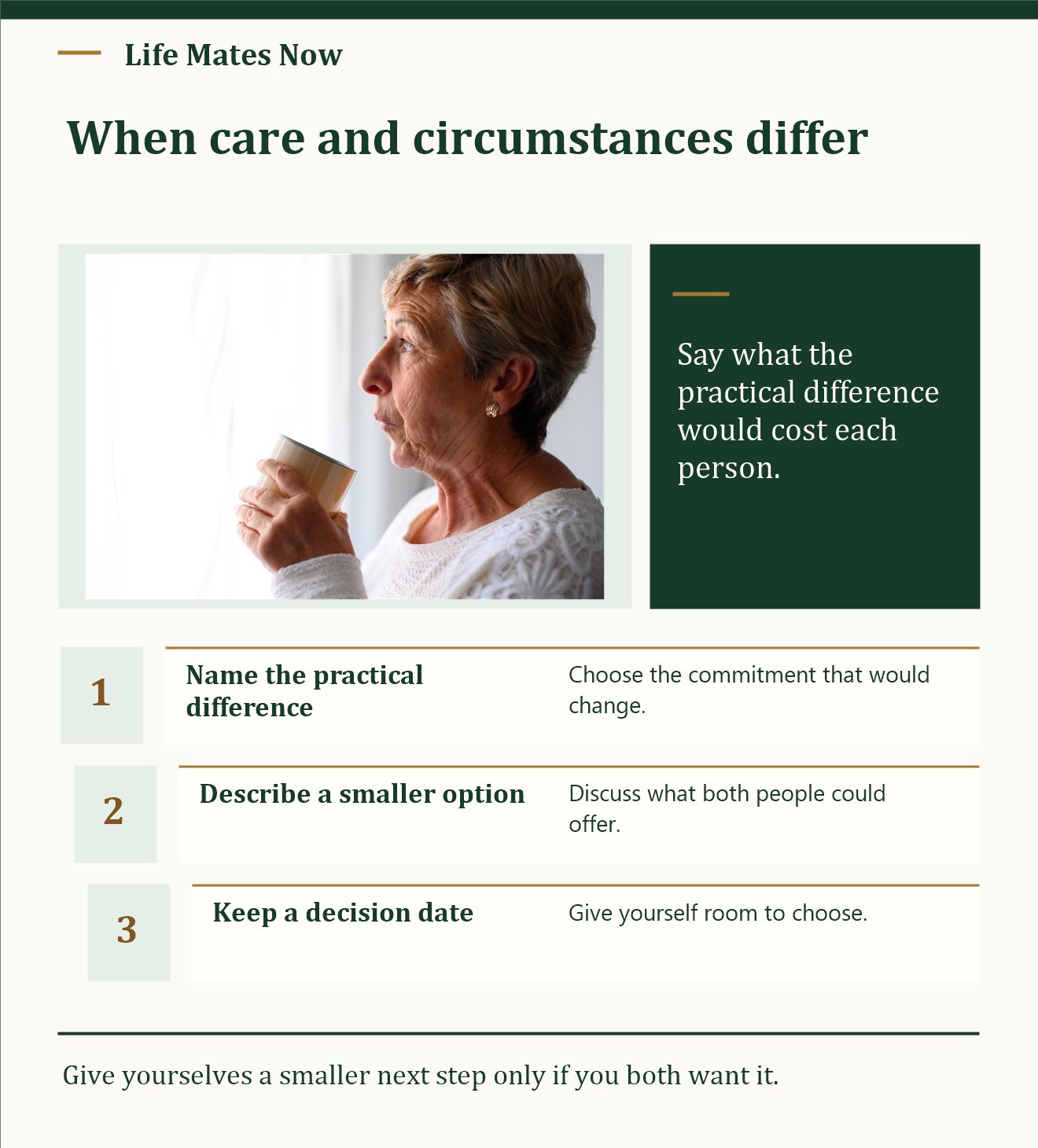
Read the infographic in text
When care and circumstances differ
Say what the practical difference would cost each person.
- Name the practical difference Choose the commitment that would change.
- Describe a smaller option Discuss what both people could offer.
- Keep a decision date Give yourself room to choose.
Give yourselves a smaller next step only if you both want it.