

Resentment toward a partner can feel like a collection of unresolved moments: a responsibility repeatedly left to you, a promise not kept or a hurt that never received a serious response. You may still care about the person while feeling angry or worn down.
You do not have to decide that the marriage is doomed or force yourself to forgive. Start by understanding what is happening, what needs to change and whether both people can take part in a respectful response.
On this page

Name what you feel resentful about
Choose a recent example. What happened, what had been agreed and what did it leave you handling or feeling? Describing one pattern is more useful than trying to prove that your partner has a fixed character flaw.
Resentment may relate to an uneven workload, a broken agreement or feeling unheard. It is worth checking which of these fits your experience rather than assuming every unhappy marriage has the same cause.
Notice how previous conversations went. Were concerns heard and followed by action, or did the discussion become a contest about who was right? That pattern can help you decide how to raise the issue.
Try replacing “You are selfish” with an observation such as “I have handled the last four evening routines after we agreed to share them.” You can be clear about the impact without guessing the other person’s motives.
Also distinguish something never discussed from an agreement repeatedly ignored. Both can need attention, but they call for different questions about expectations and responsibility.
Separate ordinary conflict from being harmed
Threats, intimidation, violence or control are not simply communication problems for both partners to solve. If you feel afraid, seek individual support from a suitable domestic-abuse service and consider your safety before arranging a confrontation.
Your feelings deserve attention even when your partner sees the situation differently. Disagreement does not justify humiliation, punishment or pressure to stop speaking about what affects you.
After infidelity or another serious breach of trust, a request to “move on” may leave the original harm unresolved. You can ask for responsibility and changed behaviour without promising to stay or forgive.
Understand how the pattern affects daily life
You might avoid conversation, feel less interested in shared plans or notice that small disagreements bring up older hurts. Describe what has changed for you rather than diagnosing the relationship from a list.
Less sex, quieter evenings or time apart do not by themselves establish resentment or lack of love. Ask about the experience behind the change. Neither partner owes sex or affection as evidence that things are improving.
Ask for a practical change you can review
If it is safe to talk, choose one issue and a time when you can both give it attention. Explain the pattern, the effect and a request: “I am exhausted doing the evening tasks alone. Can we decide who will handle each task this week?”
You can prepare notes or ask for a pause if the conversation becomes overwhelming. Expressing a concern does not require explaining every past hurt at once.
Make the agreement concrete. Who is responsible, what does completing the task include and when will you check whether it is working? Avoid an arrangement that leaves you managing and reminding someone to do their share.
An older hurt may need a separate conversation about acknowledgement and repair. Writing it down can help clarify what remains unresolved; it does not create an obligation to keep reliving it.
Forgiveness is a personal choice. It cannot substitute for changed behaviour, and you do not have to forgive on a deadline to deserve support or decide what comes next.
Choose support and assess the response
You can talk with a trusted person or qualified counsellor while respecting reasonable privacy. Keeping every concern between you and your partner is not a requirement of loyalty, particularly if you feel isolated.
A calm tone may make a discussion easier, but finding perfect words cannot make another person cooperate. Notice whether they listen, take responsibility for their part and participate in a workable change.
You can recognise a partner’s good qualities and still take repeated harm seriously. Gratitude does not cancel an unfair arrangement or remove your right to a boundary.
Couples counselling may be an option when both people can speak freely. The National Domestic Violence Hotline advises against joint therapy with an abusive partner; individual safety support is a different and important option.
Review actions rather than promises alone. You might continue repair, revise your arrangements or consider separation. The goal is a life and relationship you can participate in freely, not preserving a marriage at any cost.
Read the infographic in text
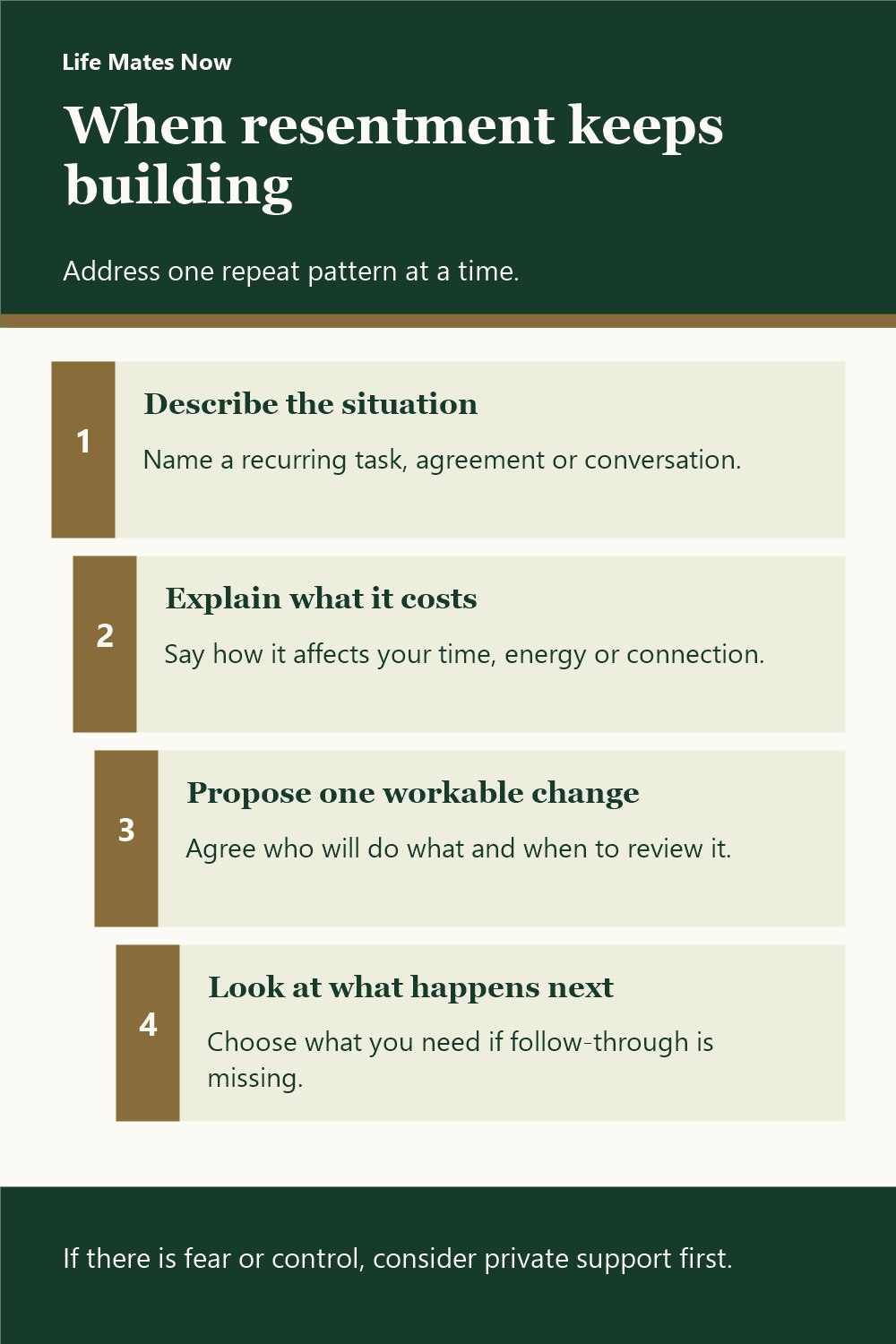
When resentment keeps building Address one repeat pattern at a time.
- Describe the situation Name a recurring task, agreement or conversation.
- Explain what it costs Say how it affects your time, energy or connection.
- Propose one workable change Agree who will do what and when to review it.
- Look at what happens next Choose what you need if follow-through is missing.
If there is fear or control, consider private support first.