

Hearing “I love you” can matter deeply. It may also leave you confused when the person saying it repeatedly dismisses your needs, breaks agreements or hurts you. You do not have to decide whether their feelings are real before considering how you are being treated.
Affection and respectful behaviour need attention together. A useful question is whether there is room for both people to speak, make choices and keep personal limits. Love does not require accepting everything, forgiving on demand or staying in a relationship that does not work for you.
On this page

Look at words and behaviour together
Describe the interaction that concerns you. Perhaps a person agrees to listen, then mocks you for raising the issue. Perhaps they promise to share a responsibility but repeatedly leave it to you. Specific examples can help you identify what you want to discuss or change.
A mistake and a continuing pattern may call for different decisions. Notice how the person responds when something goes wrong: do they acknowledge it, consider its effect and take part in finding a workable response? You do not need a flawless partner, but your concerns deserve attention.
A person’s feelings cannot be established by a checklist. Warm words do not settle questions about reliability, consent or compatibility. You can value their affection while deciding that a particular arrangement or behaviour is not acceptable to you.
Keep room for preferences and limits
Accepting someone as a person does not mean agreeing with every choice they make. You can care about a partner and want quieter evenings, time with friends, more reliable plans or a different division of household work. Expressing a preference is not a failure to love.
Try making the concern concrete: “When plans change, I need you to tell me,” or “I want us to discuss chores instead of assuming I will do them.” The aim is to explain what matters and find out whether a workable agreement is possible.
Some limits concern personal privacy or physical closeness. The love is respect guide to boundaries offers examples of emotional, physical and digital limits. A relationship does not create an automatic right to another person’s passwords, private experiences or affection.
Ask what an apology changes
An apology can open a conversation, but it does not require immediate forgiveness or restore trust by itself. You may need time, information or a different arrangement. You can acknowledge that someone is sorry while still feeling hurt or undecided.
Useful repair addresses the specific behaviour. If a shared plan was ignored, an agreement might explain how changes will be discussed next time. If hurtful comments were made, repair includes stopping those comments rather than asking you to stop mentioning their effect.
Notice whether responsibility stays with the person who made the choice. “I am sorry, but you made me do it” shifts blame. You do not have to accept blame for someone else’s threats, humiliation or pressure to make the conversation easier.
Notice when a request becomes pressure or control
A partner can feel disappointed by an answer and still respect it. Repeated demands, punishment for saying no or attempts to isolate you from other people deserve attention. The phrase “If you loved me” does not turn an unwanted request into an obligation.
Consider whether you can disagree without fear. Are you free to keep friendships, make ordinary decisions and decline physical contact? Notice the behaviour rather than searching for a label that explains the person’s character. Your limits matter without a diagnosis or a verdict about their intentions.
If you are afraid of how someone may react, consider confidential support before confronting them or announcing plans. A local domestic-abuse service can help you think about safety and practical options. You do not have to attempt another discussion to prove that you tried hard enough.
Choose what happens next without needing a perfect explanation
Your next step might be asking a direct question, proposing a specific agreement, seeking individual support or deciding to end the relationship. Consider what would help you make the choice and which practical arrangements need attention. You can take time when it is safe to do so.
You may still care about the person after choosing a boundary or leaving. Affection does not erase a mismatch, and sadness does not automatically mean the decision was wrong. A trusted person can listen without insisting that you forgive, stay or reach a conclusion immediately.
Love does not make one person responsible for meeting every need or accepting ongoing harm. Give weight to the treatment you receive, the choices available to you and what you need from a relationship. Those things matter alongside the words a partner says.
Find out what an apology changes in practice
Suppose a partner says they respect your interests but keeps asking you to drop a class whenever they want to see you. Describe the behaviour and say what you want to keep. Ask which other time you can both offer.
Notice how they handle the next request. You can give repeated actions weight when deciding which agreements and contact you want to continue.
Read the infographic in text
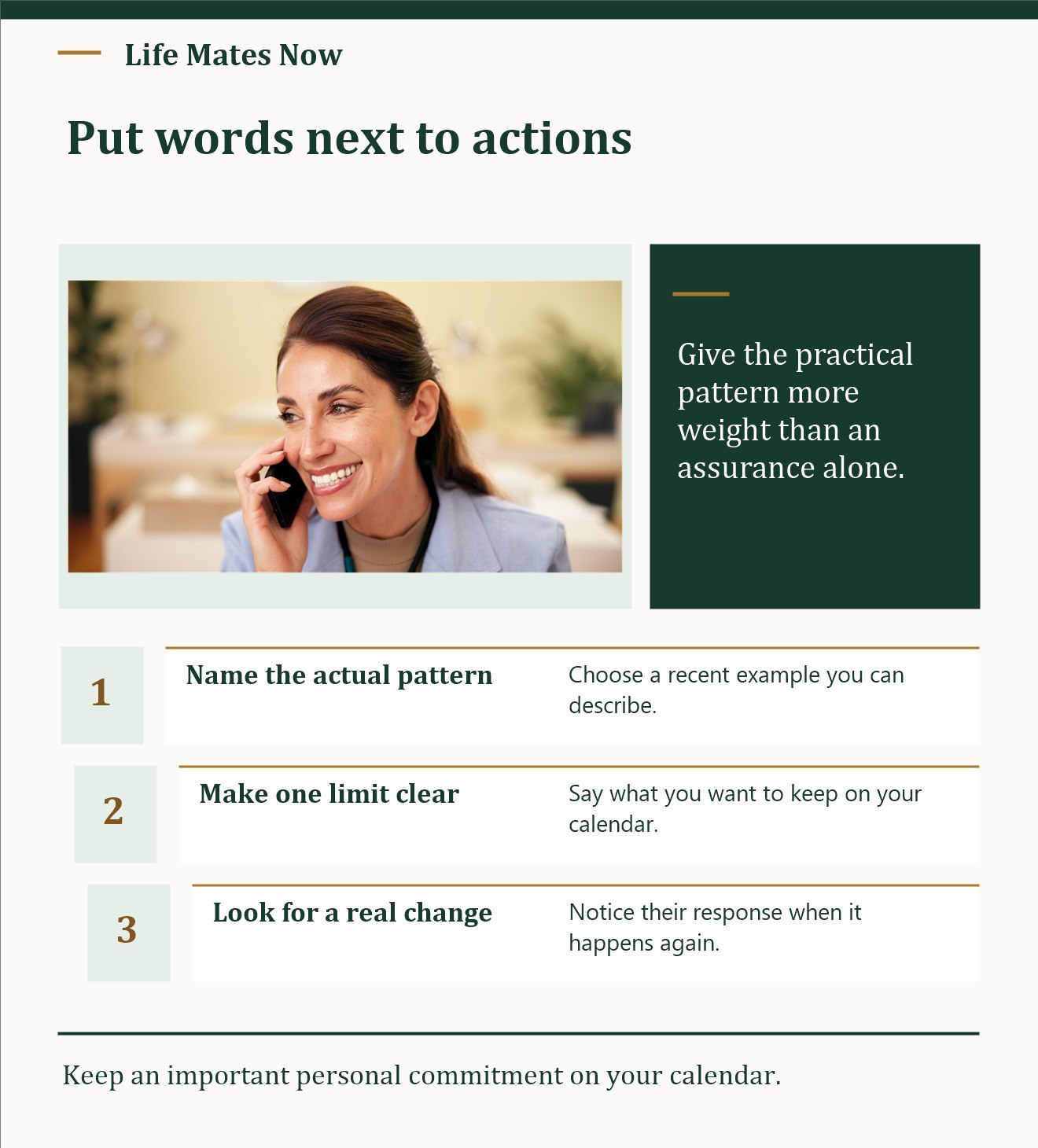
Put words next to actions
Give the practical pattern more weight than an assurance alone.
- Name the actual pattern Choose a recent example you can describe.
- Make one limit clear Say what you want to keep on your calendar.
- Look for a real change Notice their response when it happens again.
Keep an important personal commitment on your calendar.