

People use “the seven-year itch” to describe a stretch of restlessness or distance in a long relationship. That feeling can come up at any point. Start with what has changed in daily life, and ask what each of you has room to do about it.
On this page
Notice what has changed
Pick one example from the last week, such as going to bed at different times or only talking about errands. Ask “What part of our week feels different to you?” Use the answer to learn what each person is experiencing.
Take responsibility for your part
In my own marriage, I’ve found it both uncomfortable and empowering to look at my own choices. I can say what I miss and notice how I respond when I feel tired or overlooked. Each partner is responsible for their own behavior.
Name one thing you appreciate
Tell your partner about something concrete you noticed, such as taking a difficult call or making time to listen. You can recognize their effort while still discussing a concern that needs attention.
Ask what feels caring this week
One person may want help with a task and another may want time together. Try asking what would make this week easier. Make one offer you can follow through on and let your partner say what would actually help.
Make space for friendship
My favorite part of my marriage is our friendship. It has helped us through challenges and made the good times better. Choose something small you both enjoy, such as a walk, a shared meal or a conversation that has nothing to do with the household list.

Share the work of home and parenting
Look at the week together and name the tasks each person is carrying. If one of you has little time to rest, agree on one change that redistributes the work. Choose time together that fits the family’s schedule.
Check what changed and what still needs attention
After a week or two, ask whether the change helped both of you and what you want to try next. If you keep getting stuck and both feel safe participating, a qualified couples therapist can help you talk it through. If you are worried about threats, retaliation or control, seek private support before a joint discussion.
Find a routine that once worked and ask whether it still fits
If Sunday mornings used to be the best time to catch up but now one person works, choose another small slot you can both keep. Ask what feels scarce today, such as rest, a chance to talk or help finishing everyday tasks.
Try one change for a fortnight and check whether both people notice a difference. Give practical chores and time together their own attention so you can see where more support is needed.
Read the infographic in text
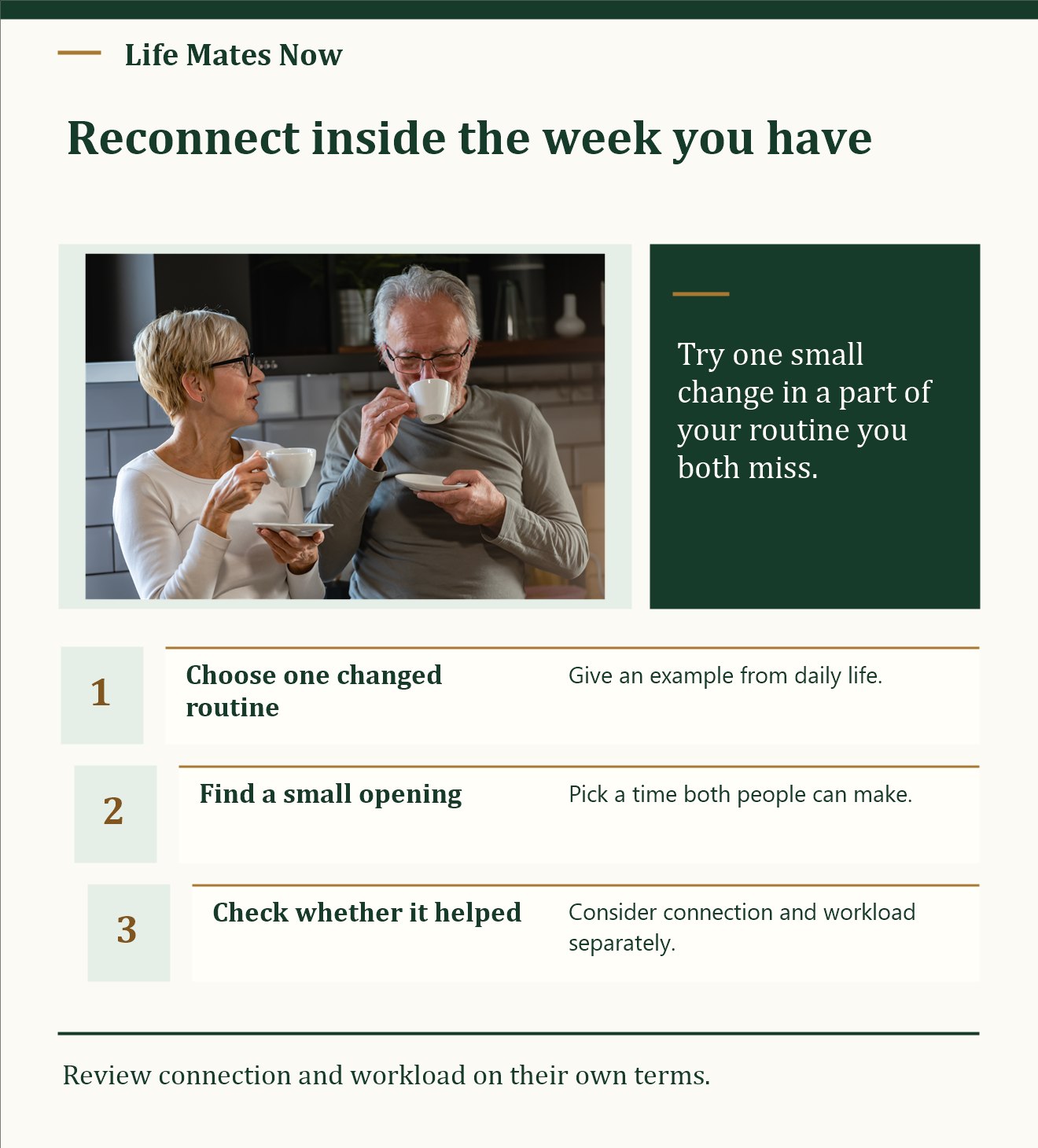
Reconnect inside the week you have
Try one small change in a part of your routine you both miss.
- Choose one changed routine Give an example from daily life.
- Find a small opening Pick a time both people can make.
- Check whether it helped Consider connection and workload separately.
Review connection and workload on their own terms.