

Wanting a closer relationship does not mean you know how to put every feeling into words. You may need time to understand a reaction, prefer a different way to communicate or want to keep parts of your history private. None of those things makes openness a quality that belongs to one gender.
The useful question is what you can honestly offer and what you would like to change. Sharing should be a choice. You and your partner can discuss closeness without making disclosure a test of love or promising that one conversation will solve everything.
On this page
1. Say what is happening for you now
Start with something current and manageable. “I have been worried about work, and I have less energy to talk tonight” is a meaningful piece of information. You do not have to explain your whole life before acknowledging how you feel.
If naming a feeling is difficult, describe a sensation, concern or need instead: “I keep replaying that conversation” or “I need a quiet hour before we discuss plans.” You can say that you are unsure. Guessing at a cause just to provide an answer may make the conversation less clear.
Try to distinguish an honest limit from an agreement you do not intend to keep. “I am not ready to discuss that” is clearer than repeatedly promising a conversation you know you will avoid. Your partner can then make decisions using the information you have actually offered.
2. Choose the amount and pace of sharing
Pick one subject you are willing to discuss and one limit you want respected. You might talk about feeling overwhelmed while keeping details of a past experience private. Trust does not require access to every memory, message or password.
Ask about timing and format. A short conversation, written message or planned check-in may fit better than an unexpected late-night discussion. Choose an accessible way to communicate that works for both people rather than assuming that face-to-face speech is always best.
Love is respect’s guidance on emotional boundaries makes room for people reaching emotional milestones at different times. You can care about someone without matching their exact pace. Equally, a partner is allowed to consider whether the level of connection available meets their needs.
3. Make listening more specific
Tell your partner what kind of response would help: “Could you listen first?” “Can we think through options?” or “I would like some reassurance, but I do not need an answer tonight.” This gives them a clearer role than expecting them to know what you need.
When listening, ask before offering advice or requesting more detail. “Would you like to say more?” leaves room for a no. Avoid treating a pause, tears or an awkward sentence as evidence of dishonesty.
Being heard also includes room for different experiences. One person may feel disconnected while the other feels exhausted. You can acknowledge both accounts without deciding that only one feeling is valid or that every disagreement must be resolved immediately.
4. Agree on one small action
Choose something you can realistically repeat. Perhaps you will check in after dinner twice this week, tell each other when you need space or make one plan without devices. State the action clearly enough that you both know what was agreed.
A possible agreement is: “If I need to pause, I will say so and suggest a time to return to this.” The pause should not become an indefinite refusal to address an important issue. If the return time no longer works, communicate that rather than leaving the other person guessing.
Review whether the action helped. Ask what felt useful and what felt forced. A small agreement is information about what works for this relationship, not a guarantee of intimacy or a reason to keep increasing the amount of disclosure.
5. Consider needs, limits and support
You cannot make another person open up, and they cannot require you to reveal something before you are ready. You can each be clear about the relationship you want. Persistent differences in availability or communication may require a decision about compatibility, rather than more effort to change someone.
If you want help understanding your own patterns, individual counselling may be an option. You do not have to decide that childhood, fear or a particular diagnosis explains your difficulty before asking for support.
If sharing leads to ridicule, threats, sexual pressure or private information being used against you, prioritise safety and individual support. More vulnerability is not the solution to someone misusing what you share.
A useful next step can be modest: one honest statement, one respected limit and one action you are willing to try. Notice whether both people have room to participate by choice.
Read the infographic in text
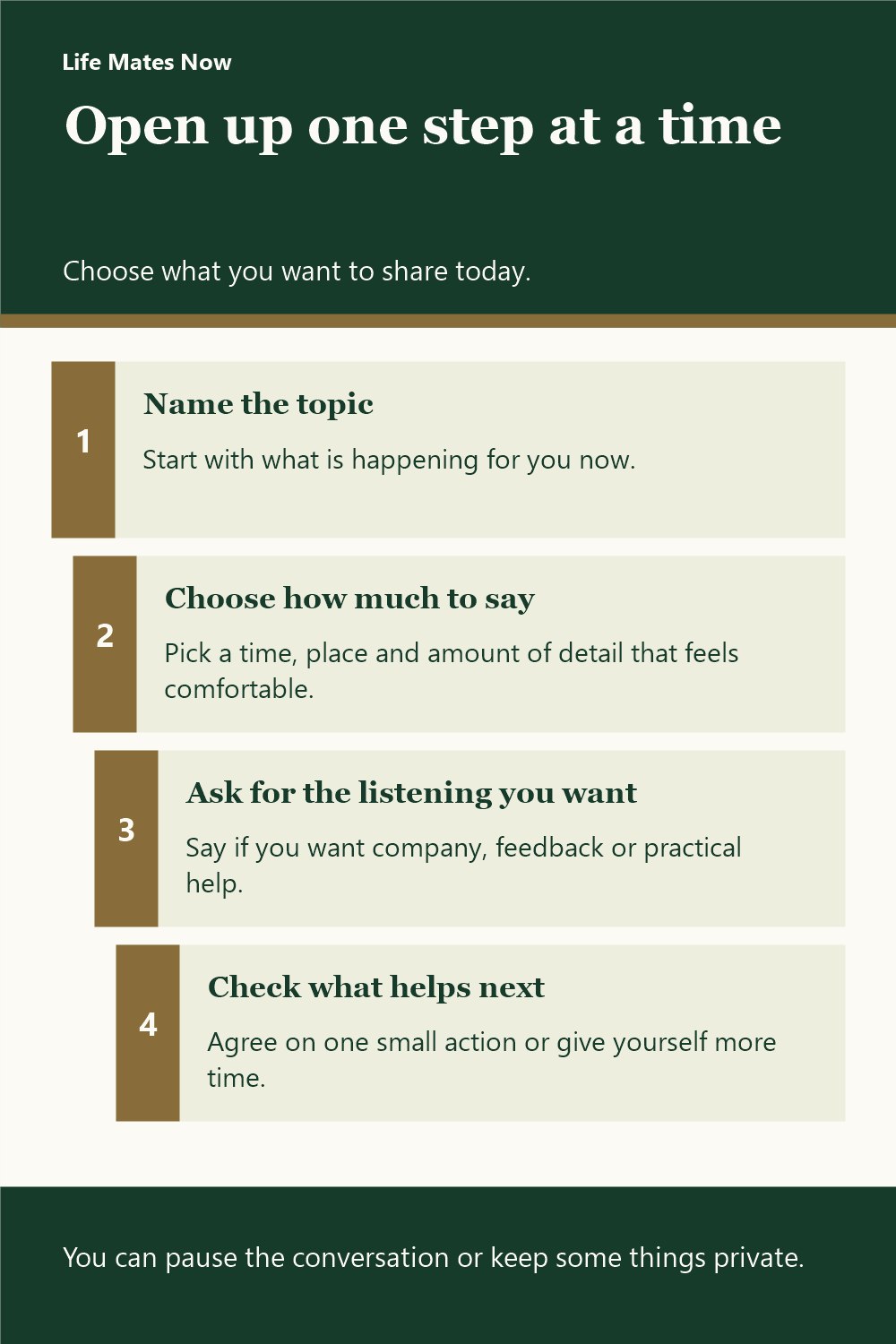
Open up one step at a time Choose what you want to share today.
- Name the topic Start with what is happening for you now.
- Choose how much to say Pick a time, place and amount of detail that feels comfortable.
- Ask for the listening you want Say if you want company, feedback or practical help.
- Check what helps next Agree on one small action or give yourself more time.
You can pause the conversation or keep some things private.