

Unhurried time together may appeal to adult partners who want more room for attention and conversation. You can explore that idea without a required sexual activity, special position or promise to transform your relationship.
Tantra has wider religious and philosophical histories in Hindu and Buddhist traditions than modern intimacy tips suggest. Imma Ramos’s Tantra: enlightenment to revolution explores that broader context. The optional, Tantra-inspired ideas here focus on everyday connection rather than presenting a traditional ritual.

Start with a freely chosen invitation
Ask whether your partner would enjoy a little undistracted time together, and leave room for “not today” or a different suggestion. Neither person needs to perform closeness to reassure the other or prove that the relationship matters.
You might choose conversation, sitting nearby or an agreed affectionate gesture. There is no requirement to become sexual or reach orgasm. Decide what you are actually inviting, rather than assuming a quiet moment must lead somewhere else.
Talk about limits and keep checking in
Discuss what each person wants, what is off limits and how you will pause. Consent to one activity does not cover another, and either person can change their mind. If someone is silent, hesitant or uncomfortable, stop and clarify rather than continuing on an assumption.
The Health Service Executive’s explanation of sexual consent describes it as mutual, freely given and ongoing. A previous yes, a relationship label or an expectation about spiritual practice does not remove the need for present agreement.
Choose comfort over a prescribed position
Sit where your body is supported: ordinary chairs, a sofa or separate cushions may suit you. You can keep your usual clothing on, change the lighting or choose more physical distance. There is no need to straddle someone, hold a pose or remain still for a set time.
Make room for different access needs, energy levels and sensory preferences. For example, one person may prefer a chair with arms while another wants more space. Agreeing on those details can be part of paying attention to each other.
Let breathing remain natural
You can simply notice that you are breathing while listening or sitting together. There is no need to synchronize, hold your breath, constrict your throat or try to enter a trance. Following a partner’s rhythm is optional, not a measure of closeness.
If focusing on breathing feels unpleasant, leave it out and return to ordinary conversation or another comfortable activity. No particular breath pattern is required for a meaningful moment, and this exercise does not promise a hormone change or healing effect.
Make eye contact optional
You may enjoy looking at each other briefly, or prefer to sit side by side and look around the room. Looking away, closing your eyes or finding sustained eye contact uncomfortable does not establish dishonesty or a lack of interest.
Ask what feels comfortable rather than treating a gaze as a test. If you want to understand a feeling or preference, invite the person to tell you in their own way. Eye contact alone cannot tell you whether a particular kind of touch is welcome.
Ask before changing touch
If you both want touch, be specific about the invitation and stay within what was agreed. A hand held for a moment might be enough; more touch is not automatically a better experience. Respond to a limit without sulking, bargaining or asking repeatedly for a different answer.
Stop if there is pain or discomfort. You do not need to push through it to make a practice work. If pain or other symptoms persist or concern you, speak with a healthcare professional rather than using an intimacy exercise as treatment.
Finish without a score or deadline
Afterwards, you could ask what felt comfortable, what to leave out and whether either person wants to do something similar again. The answer can be mixed. One quiet moment does not have to resolve desire differences, conflict or a busy routine.
You can adapt the idea, choose a different way to connect or decide it is not for you. Time together is more useful when both people have room to speak honestly than when they are trying to achieve a promised spiritual or sexual result.
Agree what the practice would involve before trying it
Some people use ‘tantra’ to describe modern exercises for attention and closeness. Historical Tantric traditions are diverse. If you want to try a quiet shared exercise, name what you’re offering, how long it would last and what each person can choose to leave out.
You could try sitting comfortably and noticing what is happening around you for a few minutes. Keep eye contact and touch optional. Ask afterward whether the other person would choose to do it again.
Read the infographic in text
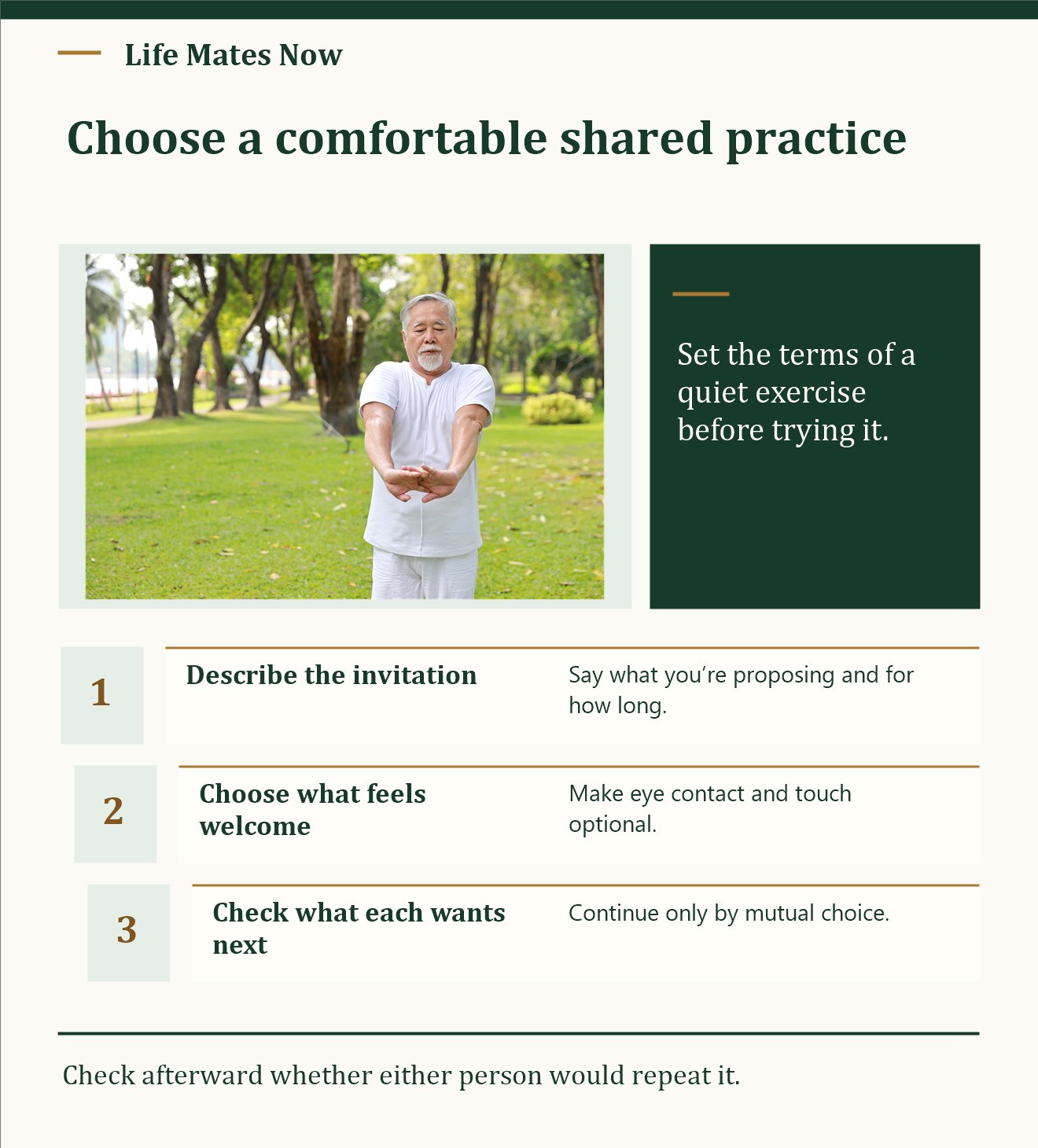
Choose a comfortable shared practice
Set the terms of a quiet exercise before trying it.
- Describe the invitation Say what you’re proposing and for how long.
- Choose what feels welcome Make eye contact and touch optional.
- Check what each wants next Continue only by mutual choice.
Check afterward whether either person would repeat it.